|
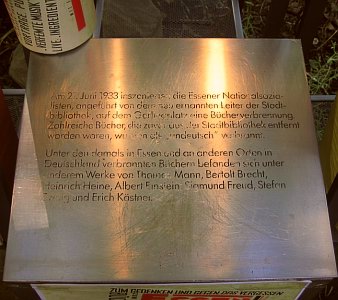
Memorial plaque at the Gerlingplatz, Essen
|
... |
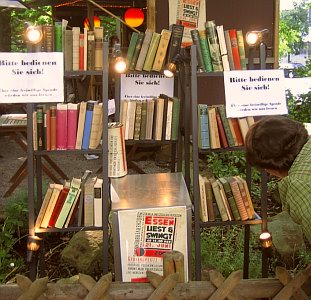
Books offered instead of Books burned
|
.
|
|
........ |
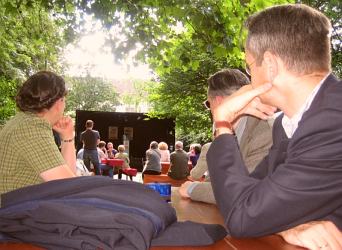
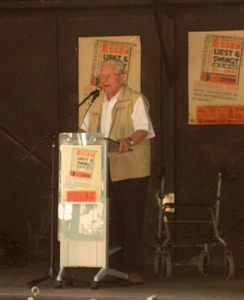
Dr. Walter Wehner recalled the often-cruel fate of persecuted authors
during the Nazi period in his impressive presentation, “Burned Books –
Murdered Poets – Forgotten Literature.” Among others, the books of
Else Ury (who authored the popular “Spoiled Baby of the Family” [Nesthaekchen]
series) were outlawed and burned because of her Jewish ancestry.
She died in a gas chamber at the Auschwitz concentration camp in January
1943. |
.
Other authors who cooperated closely with Hitler’s regime during
the National Socialist period nevertheless enjoyed successful and lucrative
publishing careers after the war. For example, the Nazi-approved
Agnes Miegel became so popular in postwar years that even streets and schools
were named in her honor. In contrast, very few of the Nazi-persecuted
writers were ever able to duplicate their prewar success.
.
|
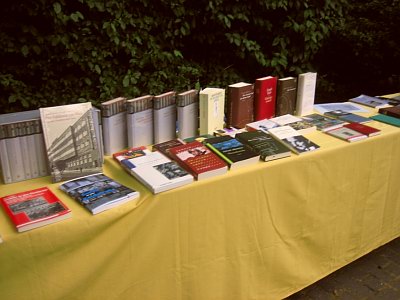
Bookstand containing literature about the Nazi
Book-Burning.
|
.. |
.
|
..
|
Dr. Ernst Schmidt
|
...... |
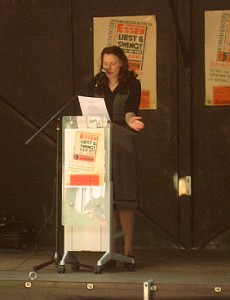
In addition to writers, other persecuted artists were also remembered.
In his readings, the well-known Essen city historian Dr. Ernst Schmidt
honored the sculptor Will Lammert, who was part of the Essen art community
during the 1920s. Lammert built a ceramic workshop in the artist colony
of Margarethenhöhe in Essen where he created significant artworks
for the city. However, in 1933 he was accused of high treason because of
his intensive work for the Communist Party of Germany (KPD). He fled
abroad and avoided arrest, but almost all his works had to be left behind
and were destroyed in his absence by the National Socialists. |
.
.
|
|
... |
Selected passages from “burned books” were read aloud as part of
our active measures against forgetfulness of the past.
Therefore, for this purpose we selected passages from the texts of
Kaestner and Tucholsky, whom we considered esteemed authors. |
... |
|
.
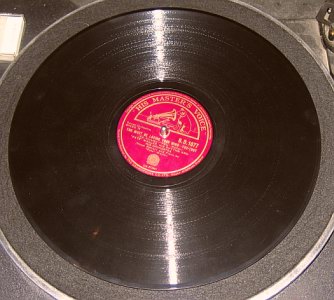
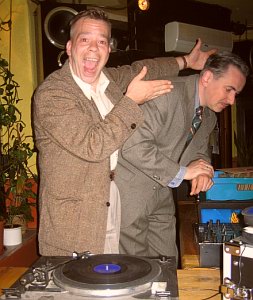
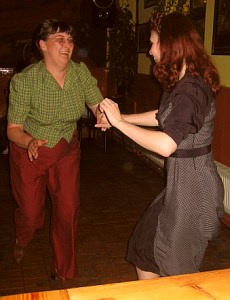
In the evening the event closed as DJ
Needlenose played “banned music” from actual records in the “Panoptikum”
shop. This Hot Swing and Jazz music was considered “degenerate” by
the National Socialists, who viewed Swing Dance as “un-German [expletive
for Black people] behavior.”
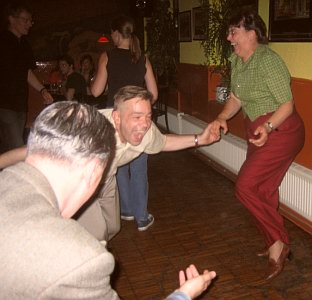
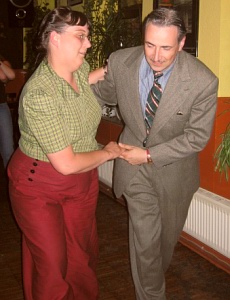
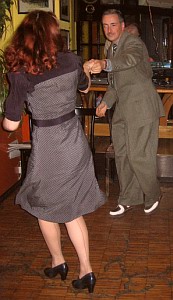
| Regardless, there were young people who were inspired by Swing music
and Swing dancing, especially in the big cities. They managed to express
their enthusiasm for Swing in many clever ways despite the numerous prohibitions
from Nazi government officials. For instance, they preferred American-
and English-style clothes instead of the uniforms of the Hitler Youth and
League of German Girls. Furthermore, the music was listened to wherever
possible and danced to in a lively “gehottet” mood.
We followed this tradition ourselves during the evening by swinging
to Swing Dance music and beat, and thereby followed the event motto to
the fullest extent, “Essen Reads and Swings.” |
...... |
. |
.
..
We wish to cordially thank the organizer engaged in this event,
by which an important contribution was made toward both memorializing those
unjustly persecuted and against forgetting the past misdeeds of the Nazi
regime.
.
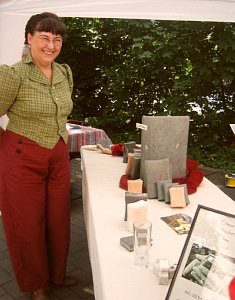
Resistance against Burning
– fire-resistant Stone Books
.
More Information about the event at
www.21-juni.info
(Many thanks to Shelby L. Stanton for English
translation)
.
Copyright © 2008 LG3949.de
.
|